A NEW SCOTTISH GOVERNMENT
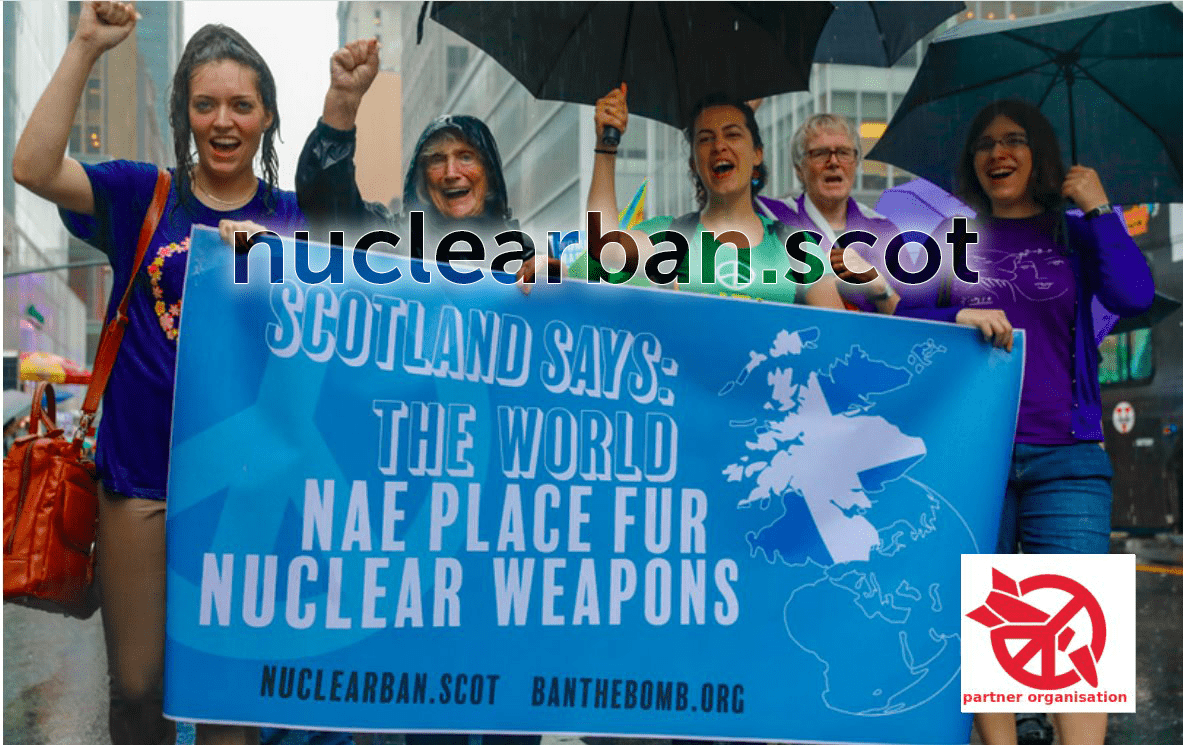
A Scottish Government for peace says ‘no’ to nuclear weapons, here or anywhere.
Scotland’s accession to the Treaty on the Prohibition of Nuclear Weapons (TPNW) and the Nuclear Non-Proliferation Treaty (NPT), along with a request that the UK Government remove its weapons at the earliest date possible, is closer than ever.
The TPNW comprehensibly bans anything to do with nuclear weapons, and recognises their disproportionate impact on women’s human rights, indigenous communities, and the environment.
By offering disarmament in good faith, the NPT gives other states good reason not to acquire nuclear weapons. This holistic approach to security for the sovereign people of Scotland would inform action on other Scottish Government policies addressing climate justice, migration, arms trading, International Humanitarian Law, and the genocide in Palestine.
ICAN’s Parliamentarian Pledge aims to get every country to sign the TPNW, now. The details are on the Parliamentary page.
EXCLUSIVE – FILM TRAILER
Watch a trailer for the documentary film ‘A Guided Tour of the Unacceptable’
To arrange a screening or view the full film, please contact hello@nuclearban.scot
Janet Fenton, ICAN Liaison in Scotland reflects on what international nuclear disarmament could mean for Scotland:
Scotland has a new parliament. It has an even bigger majority of members opposed to nuclear weapons than ever before. FM John Swinney has formed the new government. The sovereign people of Scotland hope it can improve lives, here and elsewhere, and groups and individuals are engaging with MSPs and responding to this new situation. Some of the MSPs we meet again, or greet for the first time, will be welcome as allies, while others may expect to be challenged about their agenda.
MSPs expecting significant support will include those who are committed to an equal, peaceful and sustainable Scotland, supporting disarmament, renewable energy and climate action, but saying no to genocide and war crimes. They are likely to be in disagreement with the UK policy on civil right to protest as well. This is a significant Scottish demographic that distances itself from UK ‘foreign’ policy and might prefer a transnational security approach.
As well as a backdrop of outrage at miscarriages of justice and shameful displays of reactionary racism, the election coincided with the Nuclear Non-Proliferation Treaty Review Conference (NPT Rev Con), held every five years in New York at the UN, seemingly in perpetuity. The NPT’s three pillars are: member states that don’t already have nuclear weapons must not acquire or develop them; the five nuclear armed member states (NAS) must agree not to share or modernise the ones they have, and must make good faith moves to disarmament and elimination; and lastly, all members may access and develop nuclear technology for peaceful use. Scotland has no formal say, since the UK speaks for us at the UN about these poisonous and suicidal weapons, which it deploys here, in this country, despite parliamentary opposition.
Campaigners, scientists and the medical community were far from confident of a positive outcome, given the unwillingness of the NAS (including the UK) to even discuss their disarmament obligations. Other states take some cheer from the fact that this intransigence is set against year-on-year increases in global allegiance to the Treaty on the Prohibition of Nuclear Weapons (TPNW), which came into force in 2021, providing a detailed route and the legal instrument for international (multilateral) nuclear disarmament, and which now has the support of the majority of UN member states.
This intransigence about the need for their nukes runs counter to the views of their citizens, and runs tediously and frighteningly on, despite amazing scientists presenting critical evidence, despite diplomats from non-nuclear armed states demonstrating the real security that grows when headstrong leaders are prohibited from holding insanely dangerous and overpriced weapons that put their citizens permanently at risk of attack and deprive them of necessities. So, at the Review of the NPT, the final outcome document was argued over by the NAS, with the result that the thousands of announcements and statements and important developments were neither reported nor agreed in its final analysis. Insights that could have gone to the UN First Committee, or home to Governments around the world, were abandoned in the wreckage. No final outcome document.
Relevant side events, as each pillar was discussed, were hosted by NGOs and friendly member states, with inspiring suggestions made in official statements to the delegates from member states (not least our close neighbour Ireland) as well as by well-informed civil society NGOs in attendance. In the final few days, though, even commitments agreed at previous RevCons were struck out of the outcome draft. UN disarmament chief Izumi Nakamitsu reminded the NAS not to expect the non-nuclear states to continue maintaining non-proliferation if the NAS were not fulfilling their disarmament obligations, but this was disregarded. France was bombastic in its aim to expand and gift nuclear status to others in Europe, and Australia’s ambiguity over AUKUS was quite at odds with its expression of disappointment at the lack of an outcome document. The United States’ condemnation of Iran over disputed violations was the given reason for this RevCon’s failure, but the NAS have so far never been able to consider putting their perceived security interests on the table, and the chances of them doing so now seem further away than ever.
There is a lot more information available on the NPT website, and excellent analysis through Reaching Critical Will, the disarmament programme of the Women’s International League for Peace and Freedom (WILPF), a contributing NGO in the founding of the League of Nations and then the UN. WILPF has been the official coordinator for civil society delegations’ participation at the NPT, and has produced excellent analysis and briefings throughout the meetings for many years. They make great reading, without losing any detail of the rationale or the truth of the events they log; their feminist and inclusive perspective captures the reality behind the dry statements of apologists who have no desire to bring the nuclear weapons narrative to an end.
See more on Secure Scotland’s Substack.
NATO stands for the North Atlantic Treaty Organisation, and while it sadly remains NATO policy that this military alliance is nuclear-armed, there is nothing in the North Atlantic Treaty itself that means having a nuclear weapon is a binding obligation. A policy can be changed. Joining The Treaty on the Prohibition of Nuclear Weapons involves an absolute commitment, tied into the state’s own legislation to include its terms in the law of the land. For nations that are party to it, the treaty prohibits the development, testing, production, stockpiling, stationing, transfer, use and threat of use of nuclear weapons, as well as assistance and encouragement of these prohibited activities. Ireland, a UN member state not too far from Scotland , has gone even further. Under Irish domestic as well as international humanitarian law, no state can station nuclear weapons on its soil.
That is why it is so important that a future independent, nuclear-free Scotland accedes to the TPNW as a first move for protection from threats and harassment from the UK and the US, as it would be supported by the states who have already signed the treaty, which entered into force in January 2021.
Currently, out of 193 UN member states, the TPNW has 94 signatories, (73 of which have completed full ratification). There are 9 nuclear armed states. Europe (as defined in the Herald article) is in a minority of global regions.
Large areas of the world comprise Nuclear Weapons Free Zones, agreed by treaty:
Treaty of Tlatelolco: For Latin America and the Caribbean.
Treaty of Rarotonga: For the South Pacific
Treaty of Bangkok: For Southeast Asia.
Treaty of Pelindaba: For Africa.
Central Asia NWFZ Treaty: For Central Asia.
Mongolia: a single-state NWFZ.
Antarctica, the seabed, and outer space are also designated as non-nuclear zones.
All of this information has been regularly provided to Scotland’s elected representatives and to mainstream media in Scotland frequently; in press releases and well-researched factual reports on the development and negotiations for the TPNW by those working for it since the inception of the International Campaign to Abolish Nuclear Weapons in 2007, as was equally robust work undertaken by Scottish CND, Trident Ploughshares, and Nukewatch. These have included appropriate citations and references
Mr Arnold can say that “NATO membership and trying to remove the nuclear side of the naval base at Faslane are completely incompatible” and
“If an independent Scotland wanted to join NATO it would have to accept the nuclear base at Faslane as a permanent facility”, but the Herald should at least make it clear that this is his view, and not an accurate explanation of the reality of treaty law. Theu have a responsibiity to offer something a bit clearer
I am deeply saddened that the days are past when Scottish MPs could be counted on to join the disarmament movement on the road at Faslane and Coulport, but if Mr Doogan is one of those SNP politicians who has forgotten the rise of the SNP as ‘the Bairns not Bombs party’ and he really believes that defence will not feature as a material consideration for next year’s election, I hope that he is mistaken. “Defence is reserved to Westminster and there is nothing quite as reserved as defence” he says, but if it abandons nuclear disarmament, the SNP (and others seeking to secure Scotland’s independence) will haemorrhage members and supporters at an unprecedented rate.
We are to consider who to elect the next Scottish Parliament; a different proposition than a Westminster election, where Scotland has only 59 MPs out of 660. In some parts of Scotland only14% of the electorate thought that it was worth turning out for the so-called Labour landslide at the most recent UK election. If this article is the best military and security analysis that the Herald, a Scottish national paper, can provide to inform us on the issues, devolved or reserved, then Heaven help us all.
The Scottish election will be decided through a more democratically obtained choice, and so the voters deserve that nuclear disarmament and the UK base at Faslane, a critical element in the debate is presented properly and responsibly, so that we can face the reality of what would make this a safer country. We want a parliament and government for Scotland that will stand aside from relentless and dangerous rise in militarism and threats, especially nuclear threats and focus on policies and practices for a well being economy and securing human rights, actually making this a safer welcoming, greener and fairer country in the world community.