Two Treaties and a Taste of Hope
Scotland has a new parliament. It has a bigger majority of MSPs who are opposed to nuclear weapons than has ever been the case before. FM John Swinney is establishing the new government that we hope can improve lives, here and in other places, as the sovereign people of Scotland respond to a new situation with groups and individuals are engaging with the MSPs. Some of the MSPs that we will meet again, or that we greet for the first time at Holyrood will be welcome as allies, while others may expect to be challenged about what is on their agenda.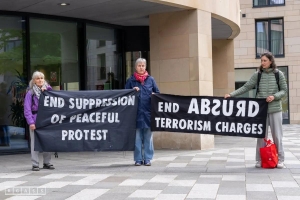
MSPs expecting significant support will include those who are committed to an equal, peaceful and sustainable Scotland, through their support for disarmament, renewable energy and climate action, and they are likely to be saying no to war crimes and genocide anywhere. They are likely to be in disagreement with the UK’s policies on civil right to protest as well, willing to use Scots Law to challenge or at least spell out the legality of legislation that affects human rights as they are understood here, and hoping for a strong Scottish position against continuing to depend on fossil fuels. This is a significant Scottish demographic, that distances itself from UK ‘foreign’ policy, and might prefer a transnational security approach to increasing resilience and more local food initiatives to reduce our dependency on imports.
As well as a backdrop of outrage at miscarriages of justice and shameful displays of reactionary racism, the election coincided with the Nuclear non-Proliferation Treaty Review Conference, (NPT Rev Con) held every five years, in New York at the UN, seemingly in perpetuity. The NPT’s three pillars are: members states that don’t already have nuclear weapons must: not acquire or develop them; the five nuclear armed member states (NAS) must: agree to not sharing or modernising the ones they have, and good faith moves to disarmament and elimination; lastly, all members may: access and develop nuclear technology for peaceful use. Scotland has no formal say at the UN, since the UK speaks for us there about these poisonous and suicidal weapons which it deploys here, in this country, despite parliamentary opposition.
Campaigners, scientists, researchers and the medical community were far from confident of a positive outcome at the review given the unwillingness of the NAS (including the UK) to even discuss their disarmament obligations. Other states take some cheer from the fact that this intransigence is set against year-on-year increases in global allegiance to the Treaty on the Prohibition of Nuclear Weapons, (TPNW) which came into force in 2021, providing a detailed route and the legal instrument for international (multilateral) nuclear disarmament, and which now has the support of the majority of UN Member States.
This intransigence about the need for their million dollar nuclear arsenals is counter to the views of the majority of citizens in both nuclear-armed states and non-nuclear armed states in the NPT, and runs tediously and frighteningly on, despite amazing scientists presenting critical evidence, despite diplomats from non-nuclear armed states demonstrating the real security that increases when headstrong leaders are prohibited from holding insanely dangerous and overpriced weapons that put their citizens permanently at risk of attack and deprive them of necessities. Despite the mounting evidence of the disproportionate impact on those with least opportunity to participate in decision making. At the Review of the NPT, the final outcome minute was argued over by the NAS, so all the thousands of visionary announcements and statements and important developments were neither reported nor agreed in the final analysis which a small minority would not reach consensus to sign off. Insights that could have gone to the UN First Committee, or home to Governments around the world, were abandoned in the wreckage. No final outcome document, again.
Relevant side events, as each pillar was discussed, were hosted by NGOs and friendly member States, and inspiring suggestions made in official statements to the delegates from member states (not least our close neighbour Ireland) as well as well-informed civil society NGO’s in attendance (including WILPF, MEDACT and many more. In the final few days though, even commitments agreed at previous RevCons were struck out of the outcome. Even when Izumi Nakamitsu, the UN Under Secretary General and High Representative for Disarmament Affairs, appealed to the NAS that they could not expect the non- nuclear states to continue maintaining non-proliferation if the NAS continued to disregard the security of non-nuclear-armed states, nor fulfil their own disarmament obligations. But France was bombastic in its aim to expand and gift nuclear status to others in Europe, and Australia’s expression of disappointment at the lack of an outcome minute to close the meeting was quite at odds with their ambiguity over how they understand nuclear sharing within Aukus not to be a violation of the NPT. The United States condemnation of Iran over disputed violations has never so far enabled them to consider putting their own (perceived) security interests on the table, and the chances of them doing so now seem farther away than ever.
There is a lot more information available at the NPT website, and excellent analysis through Reaching Critical Will, which is the disarmament programme for the Women’s International League for Peace and Freedom (WILPF), a contributing NGO in the founding of the League of Nations and then the UN, WILPF has been the official co-ordinator for the participation of civil society delegations at the NPT and has produced excellent analysis and briefings throughout the meetings for many years; they make great reading, without losing any detail of the rationale or the truth of the events they log, their feminist and inclusive perspective capturing the reality behind the dry statements of apologists who have no desire to bring the nuclear weapons narrative to an end.